
AI budgets keep climbing. Analysts forecast the global market for AI in marketing will exceed 107 billion by 2028, signaling the next phase in the evolution of digital marketing. Yet too many teams see rising costs without better forecast accuracy, faster cycle times, or higher quota attainment.
Marketing adopts powerful tools for content and campaigns, but these point solutions often create data silos that sit apart from the revenue engine. To drive real impact, marketing leaders must connect AI insights to forecasting, territory planning, and sales execution.
This guide shows how to move beyond disconnected tools and build a cohesive, AI-powered revenue engine that improves forecast accuracy and strengthens quota attainment.
The Real Challenge: Why Most AI Marketing Initiatives Fail to Deliver ROI
AI adoption in marketing has produced a paradox. Teams create more content and analyze more data than ever, yet revenue leaders struggle to tie those activities to closed-won revenue. The problem rarely stems from the tools. It stems from how organizations deploy them within the broader Go-to-Market strategy.
Most companies buy AI in silos. Marketing buys a copywriting tool, Sales buys a recording tool, and Operations runs a separate forecasting model. This fragmentation blinds leaders. In fact, 56% of marketers still use AI in isolated, ad-hoc ways, and 51% cannot track ROI or quantify the business impact of their AI investments.
When data stays inside a marketing silo, it never informs territory planning, quota setting, or sales execution. To fix this, revenue leaders must move beyond tactical implementation. Marketers need to lead with AI by integrating their workflows into the central revenue engine so that every AI-generated insight triggers a downstream operational action.
5 Ways to Connect AI in Marketing to Your Revenue Engine
Winning with AI takes more than new software. It requires redesigning how marketing data flows into sales and operations. Use these five tactics to turn marketing intelligence into RevOps execution.
1. From Personalized Content to Aligned GTM Messaging
Generative AI helps teams produce highly personalized content at scale. Speed, however, can erode consistency. If AI-generated messaging drifts from your value proposition, you confuse prospects and misalign with the sales team.
True revenue alignment requires one system of record for messaging across channels. Platforms like Fullcast Copy.ai integrate GTM strategy directly into content creation. The result: every email, ad, and landing page matches the same strategic guidance your sales reps use, so prospects hear one clear story from first touch to close.
2. From Automated Content Creation to Strategic Creativity
AI should not run your strategy. Handing the entire creative process to AI produces generic, derivative work that fails to differentiate your brand. High-performing teams use AI to set structure and free humans to make the key strategic calls.
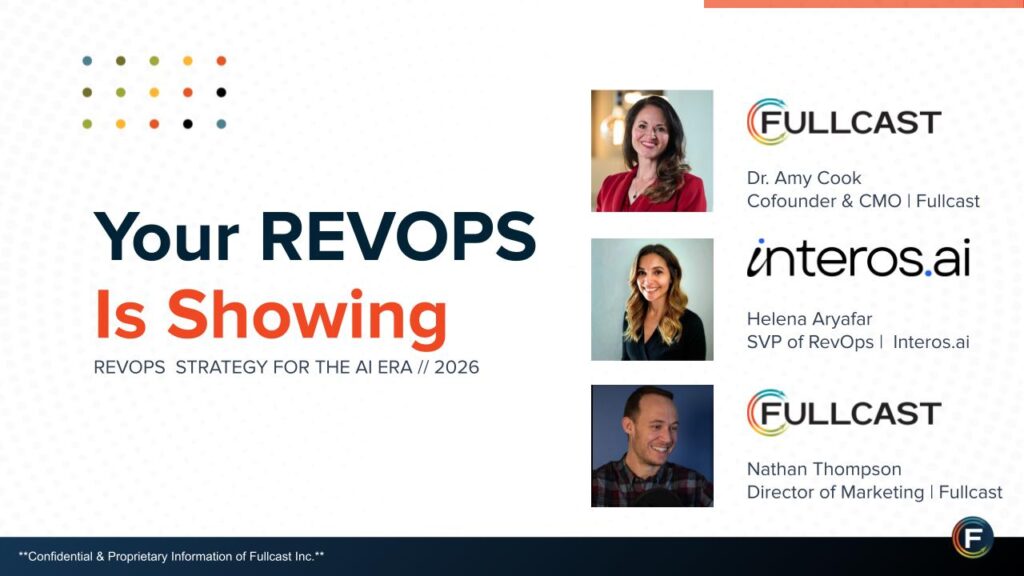
On a recent episode of The Go-to-Market Podcast, host Dr. Amy Cook and guest Nathan Thompson drew a sharp line between using AI as a crutch and using it as a scaffold for creativity. As Thompson put it, “I’ve never understood that, or at least for the past three years, I haven’t understood why marketers are outsourcing their thinking and creativity to AI instead of outsourcing the structure of their creativity and their thoughts.”
By implementing structured AI workflows, teams automate repetitive production and keep human judgment in control of the strategy. This keeps materials insightful and relevant to the complex problems your prospects need to solve.
3. From Predictive Analytics to Accurate Forecasting
Marketing teams often use AI to define ICPs and predict buying intent. Leaders waste those insights when they ignore them in territory design and quota decisions. If Marketing targets one segment while Sales incentives point elsewhere, your engine stalls.
Operationalize the data. According to our 2025 Benchmarks Report, logo acquisitions are 8x more efficient with ICP‑Fit Accounts. RevOps leaders should use predictive data from marketing to dynamically adjust territories and quotas so sales capacity focuses on accounts most likely to buy.
4. From Campaign Optimization to GTM Execution
AI can tune ad spend in real time and fill the funnel, but a campaign only works if operations keep pace. When high-intent leads sit in queues due to slow routing or poor data, the ROI of an AI-optimized campaign collapses. Operational excellence turns a marketing lead into a sales opportunity.
Consider Degreed. They consolidated four routing tools into a single Fullcast solution and achieved “zero-complaint lead routing.” With automated lead routing that matches campaign velocity, they captured and acted on valuable demand immediately.
5. From Efficient Workflows to Revenue Growth
The point of AI in marketing is not time saved. It is more pipeline, higher win rates, faster cycle times, and more accurate forecasts. High-performing companies know this. McKinsey reports that 80% of them use AI to drive growth, not just cut costs.
To sustain growth, your GTM stack must absorb more volume without breaking. Copy.ai shows how this works. By using Fullcast to manage revenue operations, they managed 650% YoY growth. When AI-driven efficiency sits on a robust operational backbone, companies scale predictably and keep processes intact.
Build Your AI-Powered Revenue Engine
The value of AI in marketing does not come from a single tool. It comes from a connected system. Standalone AI applications generate insights that rarely affect revenue. An integrated Revenue Command Center translates those insights into predictable results by connecting marketing intelligence directly to sales execution.
The question is no longer if you should adopt AI, but how you will wire AI into your entire Go-to-Market motion. Stop optimizing campaigns in a silo and build a system where marketing data informs territory design, quota setting, and sales performance. This shifts AI from a marketing tactic to a core component of your revenue engine.
Prove the model with a focused pilot. Start small, tie marketing signals to territory and quota decisions, and measure the revenue impact. Then scale what works. Use this playbook to run a high-impact AI pilot that connects marketing directly to GTM execution and measurable growth.
FAQ
1. Why isn’t AI delivering ROI for most marketing teams?
A common reason AI fails to deliver a return on investment is fragmentation. Many organizations adopt powerful AI tools in silos, where they operate disconnected from the company’s broader Go-to-Market (GTM) strategy. This isolation creates significant operational complexity. For example, an AI-powered content tool might generate high-quality leads, but if that data is not integrated with the sales CRM, the handover fails. This disjointed approach prevents teams from tracking the true business impact of their AI investments, turning promising technology into a source of inefficiency instead of a driver for revenue.
2. How should AI in marketing be integrated to drive results?
To generate measurable results, AI must be woven into the entire revenue engine, not just applied to isolated marketing tasks. A strategic integration ensures that AI-driven insights translate directly into business impact. Key steps include:
- Centralize GTM Strategy: Anchor all AI initiatives to your core Go-to-Market goals to ensure alignment across teams.
- Connect Data Systems: Integrate AI platforms with your CRM and other sales operations tools. This allows insights, like ideal customer profiles, to flow seamlessly to downstream functions.
- Link Insights to Execution: Use AI-powered analytics to directly inform sales activities, such as refining sales territories, setting realistic quotas, and prioritizing high-intent leads for immediate follow-up.
3. Can AI-powered content personalization work without GTM alignment?
No, disconnected personalization efforts are ineffective and often counterproductive. When AI-generated content is not aligned with the core Go-to-Market strategy, it creates a confusing and disjointed customer experience. For instance, an AI might personalize an email campaign around a specific product feature, but if the sales team is focused on a different value proposition, the buyer receives conflicting messages. This misalignment undermines trust and creates friction between marketing and sales, ultimately preventing the personalized content from converting prospects into customers. True success requires that all messaging is anchored to a unified strategic position.
4. What’s the right way to use AI for creative marketing work?
The right approach is to use AI as a strategic partner that enhances, rather than replaces, human creativity. AI should be leveraged to handle operational and repetitive tasks, freeing up marketing teams to focus on high-level strategy and innovation. An effective framework includes:
- Automating Structure: Use AI to manage project timelines, organize creative assets, and analyze performance data to identify patterns in successful campaigns.
- Accelerating Ideation: Employ AI tools to generate initial concepts, headlines, or design variations, providing a strong starting point for creative exploration.
- Empowering Human Strategy: Reserve final creative decisions, brand storytelling, and strategic positioning for human marketers, whose intuition and deep market understanding are irreplaceable.
5. How do you turn marketing AI insights into revenue impact?
Turning AI insights into revenue requires a direct, operational bridge between marketing analytics and sales execution. Raw data has no value until it triggers a specific action that drives a commercial outcome. To achieve this, leaders should:
- Operationalize Predictive Models: Ensure that insights from AI, such as an updated Ideal Customer Profile (ICP) or lead scoring model, are immediately integrated into your CRM and sales automation platforms.
- Inform Sales Planning: Use the ICP data to dynamically refine sales territories, adjust quotas based on market potential, and align compensation with strategic goals.
- Automate Sales Actions: Create workflows that automatically route high-intent leads to the correct sales representative with the full context needed for a timely and relevant follow-up.
6. Why do high-performing AI campaigns sometimes fail to deliver ROI?
Even a brilliantly executed AI campaign can fail if the organization is not operationally ready to handle its success. The return on investment often disappears in the gap between marketing and sales. For example, an AI campaign might identify a surge of high-intent leads, but if the sales team has a slow lead-routing process or lacks the capacity for immediate follow-up, those opportunities quickly go cold. Without well-defined service-level agreements (SLAs) and automated handoffs, the speed and scale advantages gained from AI are lost, leaving potential revenue on the table.
7. Should AI in marketing focus on efficiency or growth?
While AI certainly delivers efficiency gains, its primary focus should be on driving revenue growth. Viewing AI solely as a cost-reduction tool limits its potential. Efficiency gains, such as automating repetitive tasks or speeding up content creation, are valuable, but their ultimate purpose is to free up resources to pursue growth opportunities. An integrated Go-to-Market system is essential to capitalize on this. It ensures that the increased velocity and scale enabled by AI are channeled into activities that generate predictable revenue expansion, rather than just optimizing existing processes for marginal savings.
8. What separates AI tools that drive growth from those that just cut costs?
The key differentiator is integration across the Go-to-Market (GTM) stack. AI tools that only cut costs are typically isolated point solutions designed to optimize a single task, like writing email copy or scheduling social media posts. While useful, they do not impact the bottom line. In contrast, AI tools that drive growth are embedded within connected platforms. These systems link marketing insights directly to sales execution. For instance, they do not just identify a high-value lead; they automatically route it to the right salesperson with relevant context, creating a seamless path from insight to revenue.