











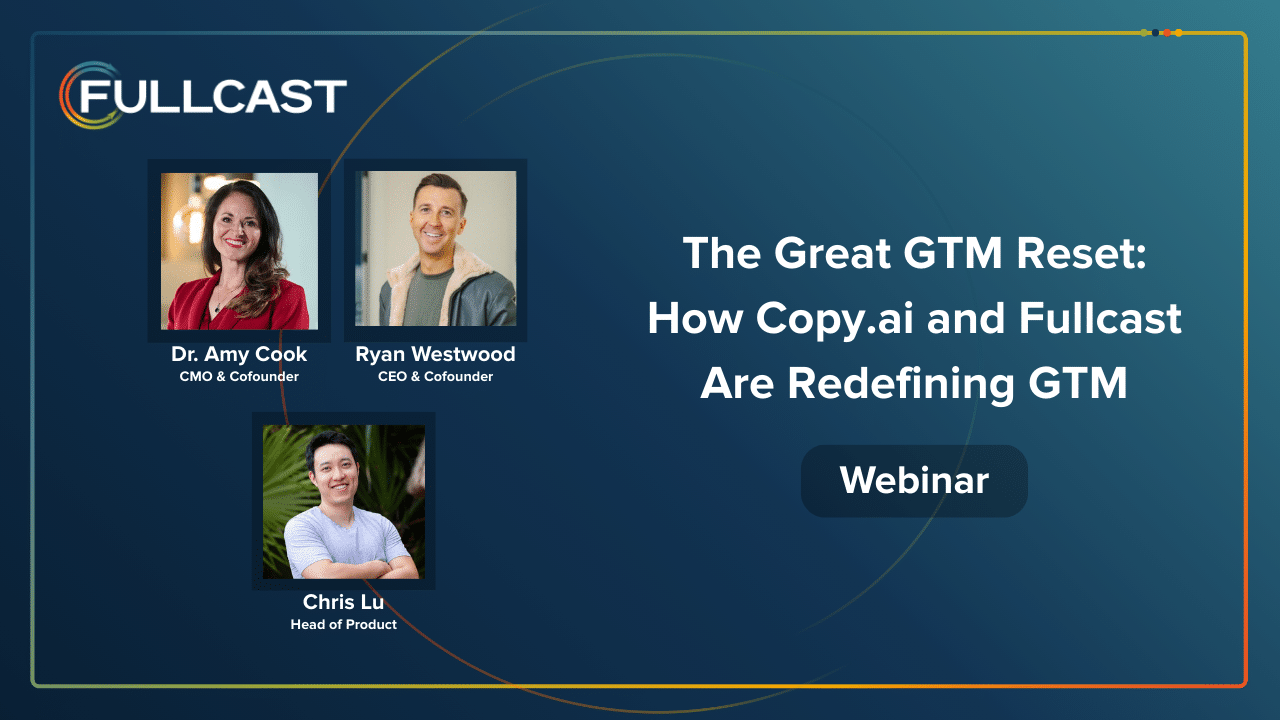
The Great GTM Reset
Something unusual happened during this webinar… something very different from the typical AI conversation dominating B2B right now. Rather than discussing “AI features,” “AI add-ons,” or “AI-powered modules,” Fullcast and Copy.ai laid out a thesis:
GTM does not need more AI features. It needs an entirely new operating system, and one that is AI-native at its core.
This is a crucial distinction.
It’s also the reason Fullcast’s acquisition of Copy.ai is more than a merger, but the beginning of a new GTM category. Nathan Thompson, Director of Marketing at Fullcast, opened the conversation by framing this shift directly:
“We’re going to talk about how go-to-market is changing, how Fullcast and Copy.ai… is making the first unified AI-native system. But more importantly, what this acquisition means for you and how these changes are going to affect go-to-market for teams like yours.”
From there, the conversation unfolded into a larger, more honest reflection on why the current GTM model is breaking, and why AI-native platforms are emerging as the inevitable solution.
Why AI-Native Matters More Than AI-Powered
The first major theme emerged early in the conversation. After years of “AI-powered” tools flooding the market, teams are realizing that layering AI on top of siloed systems doesn’t solve alignment, consistency, or execution problems. If anything, it amplifies them.
Ryan Westwood, CEO and Co-Founder of Fullcast, captured the issue succinctly:
“There are so many companies out there trying to reinvent themselves… you’re seeing it on their websites: AI-driven, AI-powered, AI features. The future is native AI.”
The distinction is more architectural than semantics. Here’s the difference:
- AI-powered systems run on fragmented tools and disconnected data.
- AI-native systems require one shared plan, one shared data layer, and one execution engine.
Fullcast’s acquisition strategy reflected that theory: acquire the core pieces of Sales Performance Management (SPM), unify them into a single backbone, then combine them with an AI-native execution layer that can bring intelligence into every part of GTM.
“You could have just slapped on a ChatGPT wrapper,” Nathan said, “but that would only scale the silos. Nothing stays connected.”
That reality is what pushed Fullcast to seek a fundamentally different approach.
The SPM Foundation Was Ready. Then AI Changed Everything
For several years, Fullcast had been quietly assembling what would become a complete SPM platform:
- Territories
- Quotas
- Capacity
- Incentive compensation
- Forecasting
- Revenue intelligence
Through the acquisition of Commissionly, Ebsta, and Atrium, the company built the backbone for planning and performance. And then, as Dr. Amy Cook, CMO and Co-Founder of Fullcast, described with refreshing candor:
“AI hit us like a wrecking ball… and our platform needed to be AI-native.”
It wasn’t enough to have the right modules. The architecture itself needed to change. Planning, routing, forecasting, compensation, content, and reporting all needed to run on the same engine.
Not separate dashboards. Not stitched-together tools. Not bolt-on AI.
The platform needed to become a unified GTM brain, capable of capturing strategy and executing it consistently across every channel.
This is where Copy.ai fit in, as the connective tissue that unifies planning with execution.
What AI-Native Actually Means
When the conversation shifted to defining AI-native, Chris Lu, CTO and Co-Founder of Copy.ai, drew a line in the sand:
“A lot of companies throw ChatGPT on top and say, ‘We have AI now.’ That doesn’t change how work gets done.”
Instead, he offered a model. AI-native means rethinking how a company:
- Collects data
- Stores strategy
- Executes every task that flows out of that strategy
It becomes the operational engine that understands the full context of GTM and executes accordingly. This definition is what transforms AI from a shiny feature into core infrastructure.
It also sets the expectation that humans remain the strategists.
“Humans will always own strategy,” Chris continued. “AI becomes the system that executes that strategy.”
This shift (from human execution to human direction) is poised to fundamentally change how revenue teams operate.
A New Org Model: No More GTM Silos
The second major theme emerged from Amy, who connected AI-native thinking to organizational theory. Revenue teams have spent decades fighting silos:
- Marketing vs. Sales
- Sales vs. CS
- CS vs. RevOps
- RevOps vs. Product
These weren’t accidents, either. They were the byproduct of 150 years of bureaucratic thinking. Amy’s point was simple but profound:
“We don’t just narrow silos. You have to remove them entirely.”
The digital era weakened these walls. AI-native GTM eliminates them.
When the GTM plan, data layer, and execution workflows all live in one system, alignment becomes the default. Each function stops producing its own version of reality. Each team stops interpreting strategy in isolation. Each workflow becomes part of a shared GTM engine.
This is the difference between operating “with AI” and operating “as an AI-native organization.”
From Checkbox GTM to Strategy-Centric Execution
Perhaps the clearest proof of an AI-native approach came through a practical example Chris shared.
It was about a problem nearly every company faces: friction between AEs and Product Marketing.
Traditionally:
- AEs request last-minute decks
- PMM spends hours building them
- Deadlines are missed
- Morale fractures
- Messaging becomes inconsistent
Chris explained how this changes when AI-native workflows are connected to the GTM plan:
“We take the product marketer’s strategy… and break it into a workflow. AEs can now request a one-pager directly in Salesforce and get it in 30 seconds—on-brand, on-message, and aligned to strategy.”
This is the manifestation of an AI-native model practicing what it preaches:
- Strategy → encoded
- AI → executes
- PMM → stays strategic
- AEs → stay enabled
- Teams → stay aligned
It’s what “intelligent GTM” actually looks like at the ground level.
What Leaders Should Take Away From This Webinar
The final section of the webinar made one truth clear: This shift is less focused on the technology and much more about how modern GTM will be run.
Here are the takeaways that matter:
1. If your stack is AI-powered, you’re already behind.
Only AI-native architectures will allow teams to execute consistently and intelligently.
2. GTM alignment is no longer optional. It’s the default operating system.
Silos kill strategy; AI-native systems remove them entirely.
3. Human creativity becomes more valuable, not less.
AI doesn’t replace thinkers, it multiplies their output and scales their creative genius.
4. Execution becomes automated. Strategy becomes the job.
This is the biggest shift in modern GTM roles.
5. AI-native is an end-to-end model.
Plan → Data → Workflow → Execution → Feedback → Optimization. All in one system, not across eight tools.
The Reset Has Already Begun
This acquisition isn’t about bundling tools. In fact, the goal was to reduce the number of tools teams need. Instead, this acquisition is redefining how GTM works, and who GTM teams can become when AI becomes the execution engine instead of an add-on feature.
Teams that adopt AI-native GTM will move faster, execute with more consistency, and regain the creative freedom that bureaucracy and tool sprawl stole from them.
The Great GTM Reset has begun. And in many ways, this webinar was its formal announcement.