










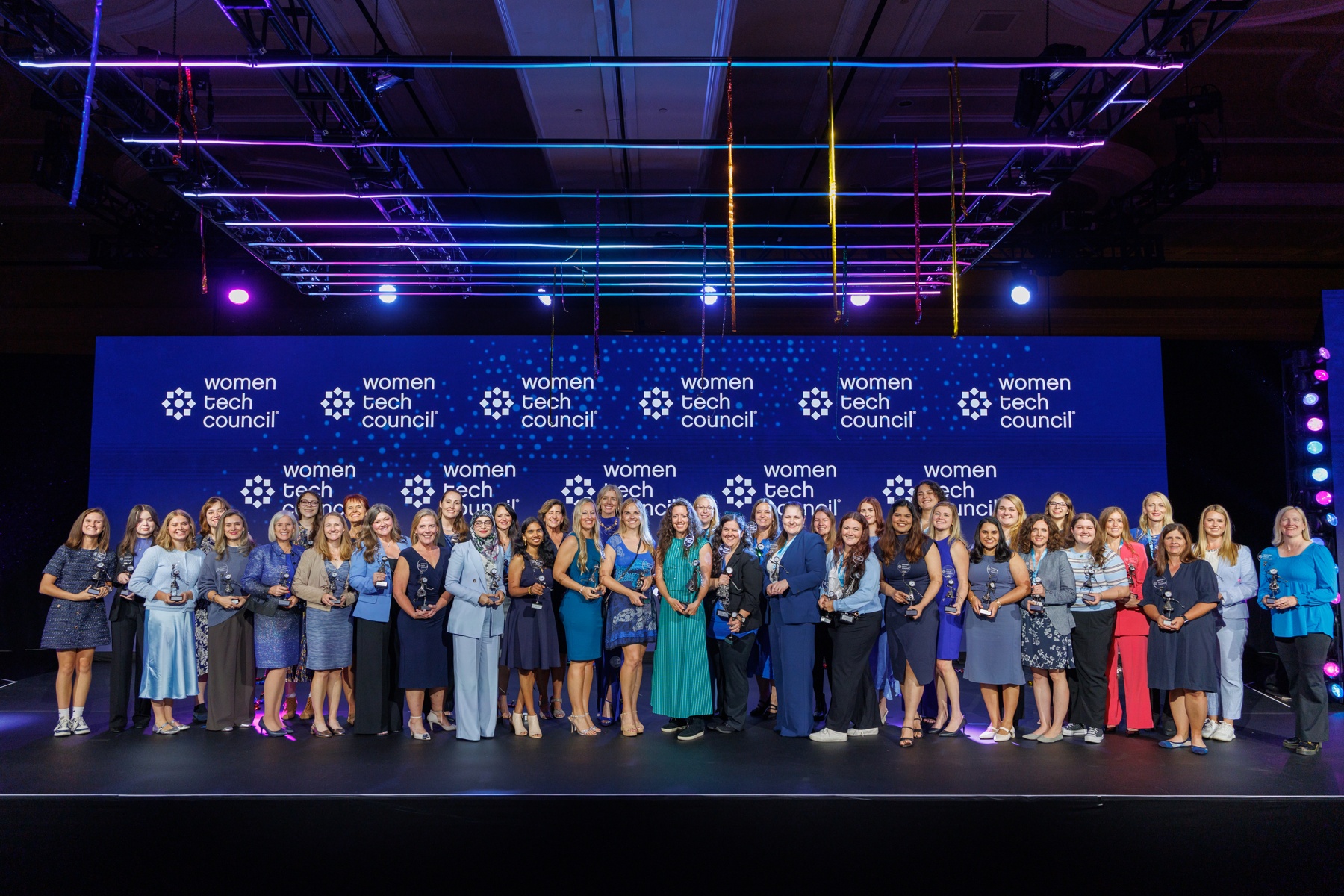
Nearly 200 high school students walked into the Grand America Hotel in Salt Lake City on Sept. 17 and got a very different answer to a familiar question:
What does someone who works in technology look like?
She might be developing technology that could one day operate on Mars. She might be using AI to change how scientists conduct preclinical research. She could be protecting financial systems from cyberattacks, overseeing technology used across hospitals, building transportation infrastructure, launching a startup or figuring out how artificial intelligence changes the way companies generate revenue.
And she might not have “technology” anywhere in her job title.
That was perhaps the most interesting story to emerge from the 2026 Women Tech Awards hosted by Women Tech Council in Salt Lake City. Forty-three women were recognized for leadership and innovation across more than 15 industries.
Fullcast CMO and co-founder Amy Osmond Cook was among them.
But look beyond any single award recipient and something much bigger becomes visible.
Collectively, these women represent more than 12 patents and 78 peer-reviewed publications. Their work has generated billions in business, financial and economic impact. Technology connected to the honorees supports 55,000 healthcare workers across 24 hospitals. Their work reaches from artificial intelligence and cybersecurity to healthcare, aerospace, financial services, transportation and space exploration.
Maybe Utah doesn’t have a shortage of women shaping technology. Maybe we haven’t been looking everywhere technology is being shaped.
Technology Doesn’t Belong to the Tech Industry Anymore
For years, Utah’s technology story has understandably centered on its software companies, entrepreneurs and the extraordinary growth of Silicon Slopes.
But technology has escaped the boundaries of the technology industry. It’s inside hospitals and banks. It’s moving trains. It’s protecting financial systems. It’s accelerating scientific research. It’s changing energy production. It’s helping companies make better decisions. And, in the case of some Utah innovators, it’s being designed for environments beyond Earth.
That makes the 2026 Women Tech Awards particularly interesting. Because the honorees don’t simply represent women succeeding inside Utah’s technology industry. They demonstrate how thoroughly technology has spread throughout Utah’s economy.
The Numbers Tell Another Story
There is historical context behind the celebration, too.
In a 2023 report, Women Tech Council noted that women represented less than 30% of the technology workforce. During that year’s wave of technology layoffs, however, women accounted for 45% of those losing their jobs.
Women leaders were also leaving companies at concerning rates. Forty-three percent cited burnout as one reason for leaving, compared with 31% of male leaders.
Those statistics make the accomplishments represented at this year’s awards worth looking at differently.
- Patents.
- Peer-reviewed research.
- Healthcare infrastructure.
- Artificial intelligence.
- Cybersecurity.
- Companies created and scaled.
- Billions of dollars in economic and business impact.
The conversation recognizes the technology women are already creating.
Forty-Three Different Answers
That may have been particularly important for the students sitting in the audience. A teenager interested in science didn’t see only software engineers.
A student interested in healthcare could see a path into health technology. Someone interested in chemistry could see a route into energy or aerospace. A future entrepreneur could see women building companies. A student fascinated by finance could discover that some of the most consequential technology careers are happening inside banks and financial institutions.
And someone who never imagined herself as a “tech person” might have discovered that the definition was bigger than she thought.
That’s what makes events like the Women Tech Awards matter beyond the trophies. Visibility changes what’s imaginable.
Utah’s Technology Story Is Bigger Than We Think
Amy Cook’s recognition provides one example. Her career spans healthcare, marketing, entrepreneurship and technology before ultimately helping build Fullcast, a Utah-founded revenue technology company.
Her path isn’t necessarily the stereotypical route into technology. But, then again, neither are many of the paths represented among this year’s honorees.
And perhaps that’s the point.
As artificial intelligence, automation, data and software become embedded in virtually every industry, the question of who qualifies as a technology leader becomes increasingly difficult to answer with a job title.
The better question might be: Who is using technology to change how something gets done?
On Sept. 17, Utah put 43 possible answers in one room. And nearly 200 students were there to see them.