










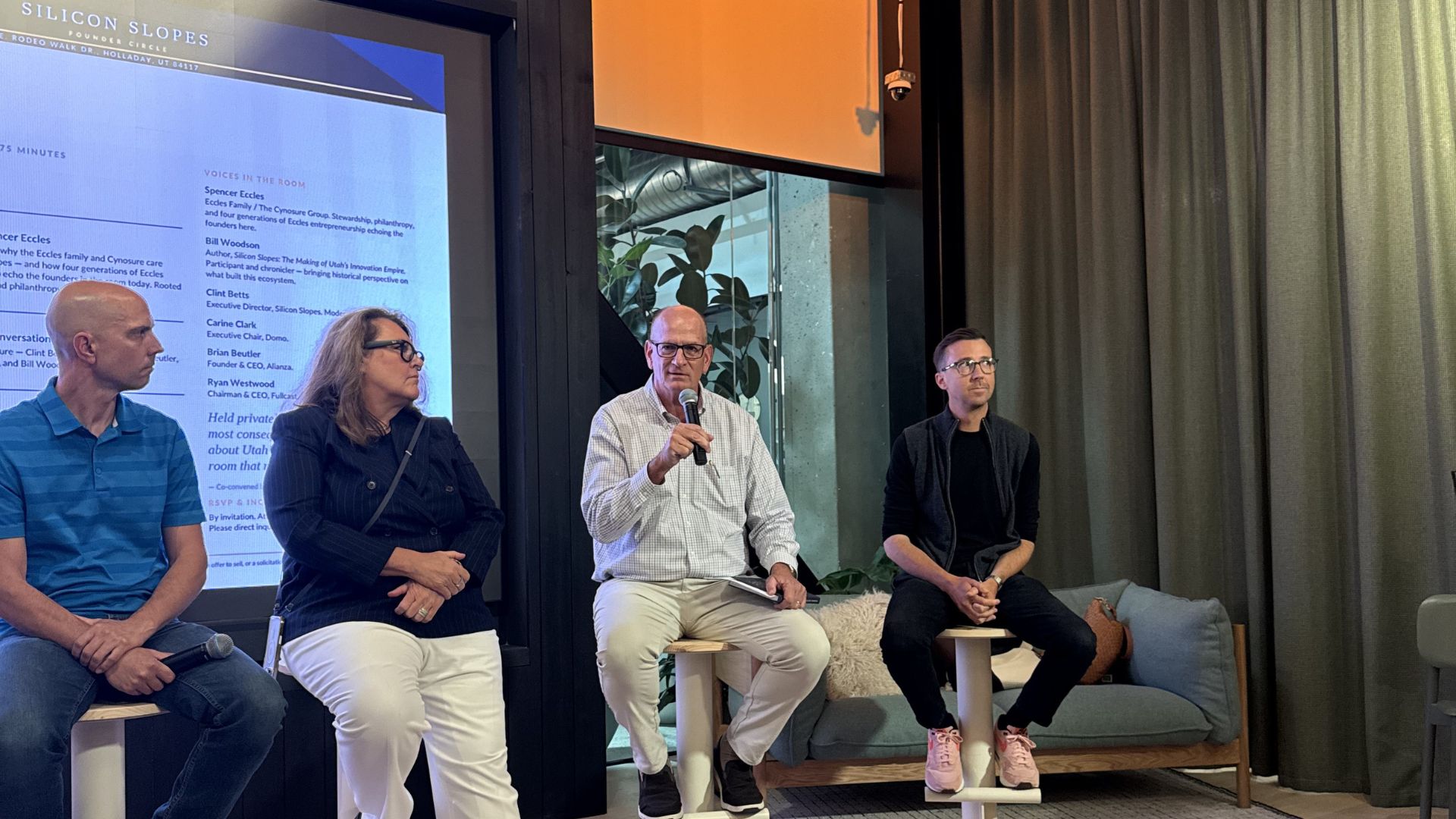
For nearly two decades, Silicon Slopes has been synonymous with Utah’s remarkable rise as a technology hotspot. What began as a grassroots effort to connect entrepreneurs has matured into one of the nation’s most influential startup communities. Yet as artificial intelligence reshapes every industry and Utah’s innovation economy enters a new era, the question is no longer how to grow. It’s how to grow wisely.
That was the central theme of the recent Founder Circle: The Next Chapter of Silicon Slopes panel, moderated by Silicon Slopes founder Clint Betts and featuring Silicon Slopes executive board member and Fullcast Founder and CEO Ryan Westwood alongside Carine Strom Clark, executive board member and CEO at First Colony Mortgage, Brian Beutler, Alianza Founder and CEO, and Bill Woodson, Managing Director and Co-Head Cynosure Wealth Advisors, The Cynosure Group. The discussion attempted to define what comes next for founders, businesses, and for Utah itself.
Building the Future Means Bringing Everyone Along

Clint Betts opened the conversation with a challenge facing every technology community. Artificial intelligence promises enormous opportunity, but public sentiment remains uncertain. Rather than assuming the future will simply happen, Betts argued that Utah has an opportunity few regions ever receive: to intentionally decide what kind of technology ecosystem it wants to become.
“We have an opportunity now, as AI is on our doorstep, to actually ask that question: Do we want this? And to make all of Utah—not just the technology industry—part of that conversation.”
For Betts, Silicon Slopes’ next chapter isn’t just about attracting investment or launching more startups. It’s about ensuring innovation benefits every Utahn.
That broader perspective set the tone for the discussion that followed.
Ryan Westwood: Success Has a Cost Few People Talk About

As the founder of multiple successful technology companies and CEO and Co-Founder of Fullcast, Ryan Westwood offered a perspective that resonated with many founders in the room because it focused on sustainability.
Building a company is often celebrated as a story of ambition. Westwood reminded the audience that ambition also carries consequences.
“You either create incredible habits in your life that replace bad habits,” he explained, “because bad habits eventually begin to surface under the intensity it takes to build companies.”
Westwood described entrepreneurship as a marathon measured in decades, not funding rounds. Creating a Fortune 500 company often requires 30 to 40 years of relentless execution. By the midpoint of that journey, many talented founders are exhausted because they’ve spent years operating at extraordinary intensity.
Rather than glorifying burnout, Westwood challenged entrepreneurs to recognize the tradeoffs. “I’ve realized that balance isn’t real,” he said. It was perhaps the panel’s most candid moment.
Building something extraordinary often demands extraordinary sacrifice. The difficult question every founder must answer isn’t whether they can keep pushing, it’s whether they should.
Knowing When “Enough” Is Enough
Westwood also explored something rarely discussed in startup culture: recognizing when ambition has reached its healthy limit.
“I’ve had to figure out where my ambition becomes too much, and when enough is enough,” he said. That philosophy reflects a defining characteristic of Utah’s entrepreneurial community.
Many founders choose family over endless expansion. After successful exits or liquidity events, they often reinvest in new companies, mentor younger entrepreneurs, serve on boards, or become angel investors instead of pursuing ever-larger valuations.
Rather than viewing that decision as settling, Westwood framed it as wisdom. Sometimes the greatest entrepreneurial decision isn’t building forever. It’s knowing when to build something else.
Does Utah Need More Fortune 500 Companies?
One of the panel’s most thought-provoking questions asked whether Utah should prioritize producing more Fortune 500 companies. Westwood believes stronger large enterprises would undoubtedly benefit Utah.
Large public companies create stable, high-quality jobs and diversify the state’s economy. But he also acknowledged the personal realities behind building one. Fortune 500 companies are good for Utah. But the challenge is whether founders are willing to become what he jokingly called “the sacrificial lamb.”
Purpose Is the Ultimate Competitive Advantage
Brian Beutler expanded the conversation by shifting attention away from valuation and toward purpose. Companies built solely to generate wealth rarely sustain founders through the inevitable setbacks.
Organizations built around a compelling mission attract better talent, inspire stronger cultures, and ultimately create greater long-term impact. It was a reminder that Silicon Slopes has never been defined simply by successful exits. Its greatest strength has always been founders willing to build companies that matter.
Betting on the Next Wave of Innovation

Carine Strom Clark offered an optimistic vision for where Utah’s next generation of transformational companies may emerge.
Pointing to advances in energy storage and battery technology, Clark predicted that innovations powering the country’s energy transformation could become one of the largest wealth-creation opportunities in modern history.
Her comments reinforced a broader theme throughout the discussion.
The next generation of iconic Utah companies may not look like the last one. They may emerge from AI, energy, healthcare, advanced manufacturing, or industries that barely exist today.
Leadership Beyond the Company
Ryan Westwood’s presence on the panel represented something larger than Fullcast’s success.
As both a Silicon Slopes board member and serial entrepreneur, his perspective reflected a broader responsibility shared by experienced founders: helping shape the ecosystem that helped shape them.
That means mentoring founders. Investing in new ideas. Asking difficult questions about growth. And ensuring Utah’s technology community remains defined not only by innovation, but by stewardship.
The Next Chapter Is Already Being Written
Perhaps the biggest takeaway from this special Silicon Slopes Founder Circle event wasn’t about AI, Fortune 500 companies, or even entrepreneurship. It was about intentional leadership.
Silicon Slopes was built because founders chose to collaborate instead of compete. Its future will depend on leaders willing to ask harder questions about sustainable growth, responsible innovation, and what kind of community they want to leave behind. As Utah enters its next era of technology leadership, the conversation is focused on building companies—and a community—that endure.